
Table of Contents
Toggle
Table of Contents
ToggleARTIFICIAL INTELLIGENCE FOR FUTURE GROWTH AI
Artificial intelligence is transforming the world with smart systems, automation, improving productivity, efficiency, and digital experiences.
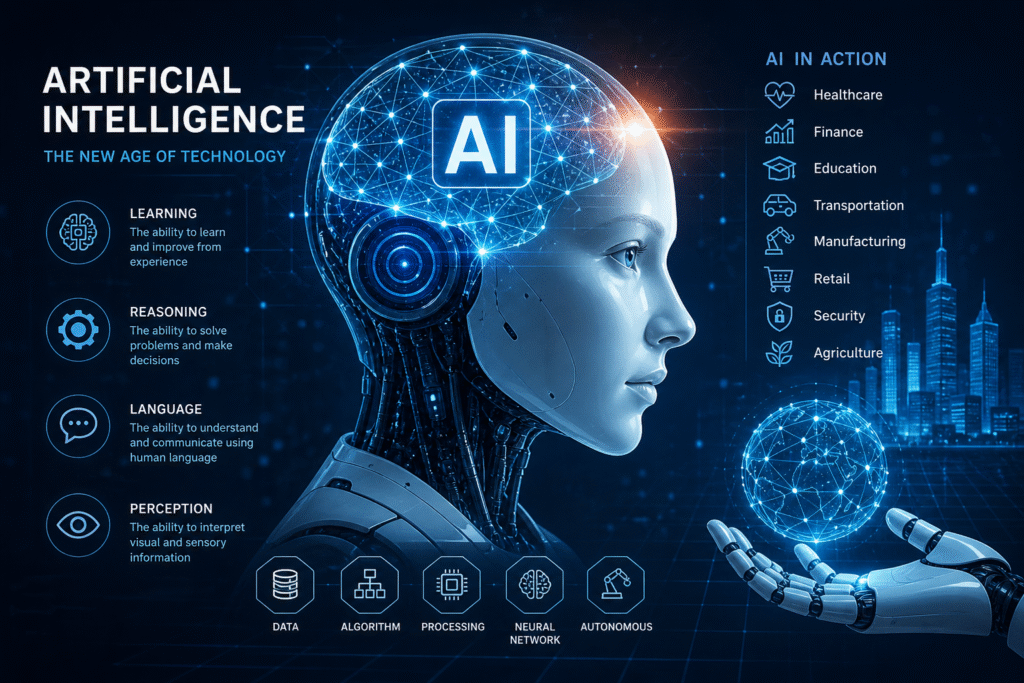
Artificial Intelligence (AI) has become a key part of modern technology, enabling machines to perform tasks that once required human intelligence. It works by using data, algorithms, and advanced computing to learn patterns, make decisions, and continuously improve performance over time.
In today’s digital era, AI is deeply integrated into everyday technologies such as smartphones, search engines, and smart devices. It helps automate repetitive tasks, analyze large amounts of data, and deliver faster and more accurate results. This not only saves time but also enhances overall efficiency across various sectors.
AI is also transforming major industries including healthcare, education, finance, and business. It supports better decision-making, reduces human error, and creates new opportunities for innovation and growth. As technology continues to evolve, artificial intelligence is becoming an essential force in building smarter systems and a more connected, intelligent world.
What is Artificial Intelligence
The question what is artificial intelligence can be answered simply — it is the simulation of human intelligence in machines.
AI systems are capable of:
- Learning from data
- Understanding natural language
- Recognizing images and patterns
- Making decisions
Artificial intelligence works by combining data, algorithms, and computing power to create intelligent systems.
Artificial Intelligence and Machine Learning
Artificial intelligence and machine learning are closely connected concepts.
Machine learning is a subset of AI that allows systems to learn automatically from data without being explicitly programmed.
Types of Machine Learning:
- Supervised Learning
- Unsupervised Learning
- Reinforcement Learning
Machine learning improves accuracy over time, making AI systems smarter and more efficient.
How Artificial Intelligence Technology Works
AI systems follow a structured workflow:
- Data Collection
- Data Processing
- Model Training
- Prediction
The more data AI receives, the more accurate and intelligent it becomes.
AI Chat GPT and Modern AI Tools
One of the biggest innovations in AI is ai chatgpt, developed by Open AI.
Chat GPT is a conversational AI model that can:
- Write blogs and articles
- Answer questions
- Help in coding
- Provide learning support
It has made AI accessible to millions of people around the world.
AI Applications in Real Life
There are many AI applications in real life:
Healthcare
AI helps in disease detection, medical imaging, and drug discovery.
Education
AI enables smart learning systems and personalized education.
Business
AI improves marketing, customer service, and decision-making.
Finance
AI is used for fraud detection and financial analysis.
Free AI Tools You Should Know
There are many free AI tools available today:
- Chat GPT
- Grammarly
- Canva AI
- Copy.ai
- Jasper AI
These tools help in content creation, automation, and productivity.
Artificial Intelligence Development and Growth
AI development has evolved rapidly over time.
Stages of Artificial Intelligence Development:
- Rule-based systems
- Machine learning
- Deep learning
- Generative AI
Modern AI can create text, images, and videos.
Artificial Intelligence for Business
Businesses are using AI to improve efficiency and growth.
Benefits:
- Automation
- Better decision-making
- Cost reduction
- Improved customer experience
AI helps companies stay competitive in the digital world.
AI in Daily Life
AI is already a part of our daily life:
- Voice assistants
- Google search
- Social media
- Online shopping
It makes everyday tasks easier and faster.
Future of AI Technology
The future of AI is very exciting.
Future Trends:
- Self-driving cars
- Smart cities
- AI healthcare
- Advanced robotics
AI will continue to evolve and transform industries.
The Role of AI in Modern Industries
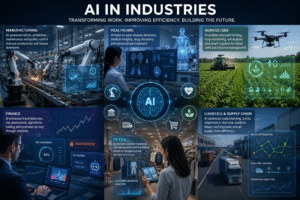
Artificial intelligence is playing a transformative role across modern industries by improving efficiency, accuracy, and productivity. Organizations are integrating AI-driven systems to automate repetitive processes, analyze large datasets, and generate insights that were previously impossible to achieve.
In manufacturing, AI-powered robots handle assembly lines with precision and speed. These systems reduce human error and increase output, making production more efficient. In retail, AI analyzes customer behavior and purchasing patterns to recommend products, manage inventory, and optimize pricing strategies.
The finance industry relies heavily on AI for fraud detection, credit scoring, and risk analysis. By identifying unusual patterns in transactions, AI systems can prevent fraud in real time. Similarly, in logistics and supply chain management, AI helps predict demand, optimize delivery routes, and reduce operational costs.
AI-Powered Automation and Productivity
Automation is one of the most significant benefits of AI technology. Businesses are increasingly using AI tools to automate routine tasks such as data entry, scheduling, and customer support.
AI-driven automation not only saves time but also allows employees to focus on more strategic and creative tasks. For example, customer service chatbots can handle common queries, freeing up human agents to deal with complex issues.
In offices, AI tools assist with document processing, email filtering, and workflow management. This leads to increased productivity and improved efficiency across departments.
The Impact of AI on Decision-Making
AI enhances decision-making by providing data-driven insights. Instead of relying on guesswork, organizations can use AI to analyze trends, predict outcomes, and make informed choices.
In marketing, AI helps businesses understand customer preferences and create targeted campaigns. In healthcare, AI assists doctors in diagnosing diseases and recommending treatment plans based on patient data.
AI systems process vast amounts of information quickly, allowing decision-makers to act faster and more accurately.
AI in Communication and Interaction
AI has revolutionized how people communicate with technology. Natural language processing allows machines to understand and respond to human language in a conversational manner.
Virtual assistants, chatbots, and voice recognition systems have become common in everyday life. These tools provide instant responses, making communication faster and more efficient.
AI is also used in language translation, enabling people from different regions to communicate without barriers. This has a significant impact on global business and collaboration.
AI and Data Analysis
Data is at the core of artificial intelligence. AI systems analyze large volumes of data to identify patterns, trends, and insights.
Businesses use AI-driven analytics to:
- Understand customer behavior
- Improve product offerings
- Optimize marketing strategies
- Predict future trends
This ability to process and analyze data quickly gives organizations a competitive advantage.
AI in Security and Risk Management
AI plays a crucial role in enhancing security and managing risks. Cybersecurity systems use AI to detect threats, identify vulnerabilities, and respond to attacks in real time.
AI algorithms monitor network activity and flag suspicious behavior, helping prevent data breaches and cyberattacks. In financial systems, AI detects fraudulent transactions and protects users from financial loss.
Risk management systems powered by AI can also predict potential issues and suggest preventive measures, reducing the chances of failure.
AI in Creative Fields
Artificial intelligence is not limited to technical tasks; it is also making an impact in creative fields. AI tools assist in generating artwork, writing content, composing music, and editing videos.
Designers use AI to create visual concepts, while writers use AI tools to generate ideas and improve their content. In the entertainment industry, AI is used to create special effects, animations, and personalized recommendations.
AI acts as a creative partner, helping individuals enhance their work and explore new possibilities.
AI and Personalization
Personalization is one of the most powerful applications of AI. By analyzing user behavior and preferences, AI systems deliver customized experiences.
Examples include:
- Product recommendations in online shopping
- Personalized content on streaming platforms
- Customized learning experiences in education
This level of personalization improves user satisfaction and engagement.
AI in Smart Technologies

AI is a key component of smart technologies such as smart homes, smart devices, and connected systems. These technologies use AI to learn user preferences and automate tasks.
Smart home systems can control lighting, temperature, and security based on user behavior. Wearable devices use AI to monitor health and provide fitness recommendations.
These innovations make everyday life more convenient and efficient.
Challenges in AI Adoption
Despite its advantages, AI adoption comes with challenges. One major issue is the high cost of implementation, which can be a barrier for small businesses.
Another challenge is the lack of skilled professionals who can develop and manage AI systems. Organizations need trained experts to handle complex AI technologies.
Data privacy is also a concern, as AI systems rely on large amounts of data. Ensuring data security and maintaining user trust is essential.
Ethical Considerations in AI
As AI becomes more powerful, ethical concerns must be addressed. Issues such as bias, transparency, and accountability are important in AI development.
AI systems can reflect biases present in training data, leading to unfair outcomes. Developers must ensure that AI models are fair and unbiased.
Transparency in AI decision-making is also crucial. Users should understand how AI systems arrive at their conclusions.
The Future Direction of AI
The future of AI technology is full of possibilities. Researchers are working on developing more advanced AI systems that can perform complex tasks with greater accuracy.
Emerging trends include:
- AI-powered robotics
- Advanced automation systems
- Integration with emerging technologies
- Improved human-AI collaboration
As AI continues to evolve, it will play a central role in shaping the future of technology and society.
The Expanding Scope of AI Technology
AI technology has rapidly expanded beyond basic automation and is now influencing almost every aspect of human life. It is no longer limited to large corporations or research labs; instead, it is widely accessible and integrated into everyday tools and systems.
Artificial intelligence is being used to enhance productivity, improve decision-making, and solve complex problems. From personalized recommendations to advanced robotics, AI is shaping the future of innovation.
The growing availability of data and improvements in computing power have made AI systems more efficient and capable. As a result, businesses and individuals are increasingly adopting AI-driven solutions.
🔹 Core Technologies Behind AI Systems
AI technology is built on several core components that work together to create intelligent systems.
Machine Learning
Machine learning enables systems to learn from data and improve over time. It is one of the most important aspects of AI.
Deep Learning
Deep learning uses neural networks to process large amounts of data and identify complex patterns.
Natural Language Processing
This technology allows machines to understand and respond to human language.
Computer Vision
Computer vision enables machines to interpret visual information such as images and videos.
These technologies form the foundation of modern AI systems.
🔹 AI in Digital Platforms
AI plays a major role in digital platforms that people use daily. These platforms rely on AI to deliver personalized experiences and improve user engagement.
Examples:
- Streaming services suggesting content
- Social media platforms customizing feeds
- E-commerce websites recommending products
AI analyzes user behavior and preferences to provide relevant suggestions, making digital experiences more engaging.
🔹 AI in Smart Devices
Smart devices are powered by AI technology, making them more efficient and user-friendly.
Examples of Smart Devices:
- Smartphones with voice assistants
- Smart home systems controlling lights and temperature
- Wearable devices tracking health
These devices use AI to learn user habits and provide personalized experiences.
🔹 AI in Transportation
AI is transforming the transportation industry by improving safety and efficiency.
Key Applications:
- Self-driving vehicles
- Traffic management systems
- Route optimization
AI systems analyze real-time data to reduce traffic congestion and improve travel efficiency.
🔹 AI in Healthcare Innovation
Healthcare is one of the most impactful areas of AI implementation.
AI is used to analyze medical data, detect diseases early, and recommend treatments. It helps doctors make more accurate decisions and improves patient outcomes.
Applications:
- Early diagnosis of diseases
- AI-assisted surgeries
- Personalized treatment plans
AI is making healthcare more efficient and accessible.
🔹 AI in Education Systems
AI is revolutionizing education by making learning more personalized and accessible.
Uses in Education:
- Adaptive learning platforms
- Virtual classrooms
- AI-based tutoring systems
Students can learn at their own pace, improving understanding and performance.
🔹 AI in Business Growth
Businesses are using AI to gain a competitive advantage in the market.
Benefits:
- Automation of tasks
- Improved customer experience
- Better data analysis
- Increased productivity
AI helps companies make informed decisions and improve overall performance.
🔹 AI in Cybersecurity
AI plays a crucial role in protecting digital systems from cyber threats.
Functions of AI in Security:
- Detecting unusual activities
- Preventing cyberattacks
- Monitoring network traffic
AI systems can identify potential threats and respond quickly to prevent damage.
🔹 AI and Big Data
AI and big data work together to provide valuable insights.
Big data provides large amounts of information, while AI analyzes this data to identify patterns and trends.
Benefits:
- Improved decision-making
- Predictive analytics
- Better understanding of customer behavior
This combination is essential for modern businesses.
🔹 AI in Creative Industries
AI is also making an impact in creative fields such as art, music, and writing.
Examples:
- AI-generated artwork
- Music composition
- Content creation
AI tools assist creators in producing high-quality content and exploring new ideas.
🔹 AI and Personalization
Personalization is one of the strongest features of AI.
AI systems analyze user preferences to provide customized experiences.
Examples:
- Personalized ads
- Custom content recommendations
- Tailored learning experiences
This improves user satisfaction and engagement.
🔹 Challenges of AI Technology
Despite its advantages, AI also faces challenges.
Major Challenges:
- Data privacy concerns
- High development costs
- Ethical issues
- Dependence on technology
Addressing these challenges is important for the sustainable growth of AI.
🔹 Ethical Issues in AI
Ethics play a crucial role in AI development.
Key Concerns:
- Bias in AI systems
- Lack of transparency
- Data misuse
Developers must ensure that AI systems are fair, secure, and trustworthy.
🔹 Future Innovations in AI
The future of AI technology is full of possibilities.
Upcoming Innovations:
- Advanced robotics
- AI-powered smart cities
- Integration with IoT
- Autonomous systems
These innovations will further enhance the capabilities of AI.
🔹 Human and AI Collaboration
AI is not meant to replace humans but to assist them.
Benefits of Collaboration:
- Increased efficiency
- Better decision-making
- Enhanced creativity
Human intelligence combined with AI leads to better results.
🔹 Global Impact of AI
AI is having a global impact by transforming economies and societies.
Countries are investing heavily in AI research to stay competitive. AI is expected to contribute significantly to economic growth in the future.
🔹 AI and the Future Workforce
AI is changing the nature of work.
Changes in Workforce:
- Automation of repetitive tasks
- Demand for new skills
- Rise of tech-based jobs
People need to adapt and learn new skills to stay relevant.
🔹 AI in Emerging Technologies
Artificial intelligence is becoming a key driver behind many emerging technologies. It plays an important role in areas like the Internet of Things (IoT), blockchain, and augmented reality. These technologies combined with AI are creating smarter and more connected systems.
In IoT, AI helps devices communicate with each other and make intelligent decisions without human involvement. For example, smart home systems can automatically adjust temperature, lighting, and security based on user behavior. In augmented reality, AI enhances user experiences by providing real-time data and interactive visuals.
The combination of AI with emerging technologies is opening new possibilities for innovation and improving the way digital systems function.
🔹 AI in Content Creation and Media
AI is transforming the way content is created, edited, and distributed. Content creators are now using AI tools to generate ideas, write articles, edit videos, and design graphics.
AI-powered platforms can analyze audience preferences and suggest content that is more likely to engage viewers. This helps creators produce relevant and high-quality content more efficiently.
In the media industry, AI is used for:
- Automated news reporting
- Video editing and enhancement
- Image generation
- Content recommendation systems
These advancements are making content production faster and more accessible.
🔹 AI in Customer Experience
Customer experience has improved significantly with the use of AI technology. Businesses are using AI to understand customer behavior and provide personalized services.
AI systems can analyze customer data to predict preferences and offer tailored recommendations. Chatbots and virtual assistants provide instant responses to customer queries, improving satisfaction.
Key Benefits:
- 24/7 customer support
- Faster response times
- Personalized interactions
- Improved customer retention
AI helps businesses build stronger relationships with their customers.
🔹 Artificial Intelligence in Supply Chain Management
Artificial Intelligence is revolutionizing supply chain management by improving efficiency and reducing costs. It helps businesses manage inventory, predict demand, and optimize delivery processes.
Artificial Intelligence systems analyze data from different sources to forecast demand accurately. This ensures that products are available when needed and reduces the risk of overstocking or shortages.
Applications:
- Demand forecasting
- Inventory optimization
- Route planning
- Warehouse automation
These improvements lead to better resource management and increased profitability.
🔹 Artificial Intelligence in Environmental Sustainability
AI is also contributing to environmental sustainability by helping organizations reduce their environmental impact. It is used to monitor and manage natural resources more efficiently.
AI systems can analyze environmental data to predict climate changes and suggest solutions for reducing carbon emissions. In agriculture, AI helps optimize water usage and improve crop yields.
Examples:
- Smart energy management systems
- Climate prediction models
- Precision farming techniques
AI is playing a crucial role in creating a more sustainable future.
🔹 Artificial Intelligence in Human Resource Management
Human resource management has also been transformed by AI technology. Companies are using AI to streamline recruitment, training, and employee management processes.
AI-powered tools can analyze resumes, identify suitable candidates, and even conduct initial interviews. This reduces the time and effort required for hiring.
Uses in HR:
- Resume screening
- Employee performance analysis
- Training and development programs
- Workforce planning
AI helps organizations manage their workforce more effectively.
🔹 Artificial Intelligence in Smart Infrastructure
Artificial Intelligence is being used to develop smart infrastructure that improves urban living. Smart buildings and smart cities rely on AI to manage resources efficiently.
Artificial Intelligence systems can monitor energy usage, control traffic flow, and enhance public safety. This leads to improved quality of life for residents.
Key Features:
- Intelligent traffic systems
- Automated energy management
- Smart surveillance systems
These innovations make cities more efficient and sustainable.
🔹 Artificial Intelligence in Research and Development
AI is accelerating research and development across various fields. It helps researchers analyze large datasets, identify patterns, and generate insights quickly.
In scientific research, AI is used to simulate experiments, predict outcomes, and discover new solutions. This speeds up the innovation process and reduces costs.
Applications:
- Drug discovery
- Material science research
- Space exploration
AI enables faster progress and opens new opportunities for innovation.
🔹 Artificial Intelligence in Personalized Marketing
Marketing strategies have evolved significantly with the use of AI. Businesses can now create highly personalized marketing campaigns based on customer behavior.
Artificial Intelligence analyzes data from different sources to understand customer preferences and deliver targeted advertisements. This increases engagement and improves conversion rates.
Benefits:
- Targeted advertising
- Better customer insights
- Increased ROI
- Improved campaign performance
AI makes marketing more effective and efficient.
🔹 Artificial Intelligence in Real-Time Decision Systems
Artificial Intelligence is widely used in real-time decision-making systems where quick responses are critical. These systems process data instantly and provide immediate solutions.
Examples:
- Traffic control systems
- Financial trading platforms
- Emergency response systems
Artificial Intelligence ensures faster and more accurate decisions in time-sensitive situations.
🔹 Artificial Intelligence in Global Connectivity
AI is improving global connectivity by enabling better communication and collaboration. It supports language translation, virtual meetings, and remote work technologies.
People from different parts of the world can now communicate easily using AI-powered tools. This has made global business operations more efficient and accessible.
AI is breaking barriers and connecting people across the globe, making the world more interconnected.
Conclusion
Artificial Intelligence technology is shaping the future of the world. Understanding what is artificial intelligence, artificial intelligence and machine learning, and tools like ai chatgpt is essential.
With growing AI applications and powerful free AI tools, AI is becoming an important part of our lives.